Product notification
This product has been discontinued, and its end-of-service date has passed. While it is no longer supported, the information on this page is still available for your reference.
|
The UltiMaker 3 is compatible with two types of print cores: AA and BB. The AA print cores can be used for printing (non-abrasive) build materials, and the BB print core is used for support materials.
Note: The UltiMaker 3 is not compatible with other print core types (AA+, CC, CC+, DD, and HT). These print cores are used for high-speed printing and/or printing composite materials. This is not supported on the UltiMaker 3.
UltiMaker material and print core compatibility
The UltiMaker 3 is compatible with all (non-abrasive) UltiMaker build materials and the support materials PVA and Breakaway. The use of composite materials (including UltiMaker PET CF, Nylon CF Slide, and PPS CF) is not supported.
UltiMaker print cores are available with several nozzle sizes:
- AA print core: 0.25 mm, 0.4 mm, and 0.8 mm
- BB print core: 0.4 mm and 0.8 mm
Not all materials can be printed reliably with all nozzle sizes. See the overview below:
| Material type | UltiMaker material | Supported print core(s) |
|---|
| General use | PLA | AA 0.25, AA 0.4, AA 0.8 |
|---|
| Tough PLA | AA 0.25, AA 0.4, AA 0.8 |
| PETG | AA 0.25, AA 0.4, AA 0.8 |
| ABS | AA 0.25, AA 0.4, AA 0.8 |
| Engineering | Nylon | AA 0.25, AA 0.4, AA 0.8 |
|---|
| CPE | AA 0.25, AA 0.4, AA 0.8 |
| CPE+ | AA 0.4, AA 0.8 (experimental) |
| PC | AA 0.25 (experimental), AA 0.4, AA 0.8 (experimental) |
| TPU 95A | AA 0.4, AA 0.8 |
| PP | AA 0.25 (experimental), AA 0.4, AA 0.8 |
| Composites | PET CF | Not supported |
|---|
| Nylon CF Slide | Not supported |
| PPS CF | Not supported |
| Support | PVA | BB 0.4, BB 0.8 |
|---|
| Breakaway | AA 0.4, BB 0.4 (added in Cura 5.11) |
Tip: The print cores listed as 'experimental' can be used (there are profiles in UltiMaker Cura), but may not always give the best results. This can depend on the model type.
Dual material compatibility
For an overview of possible dual-extrusion material combinations, take a look at the table below:
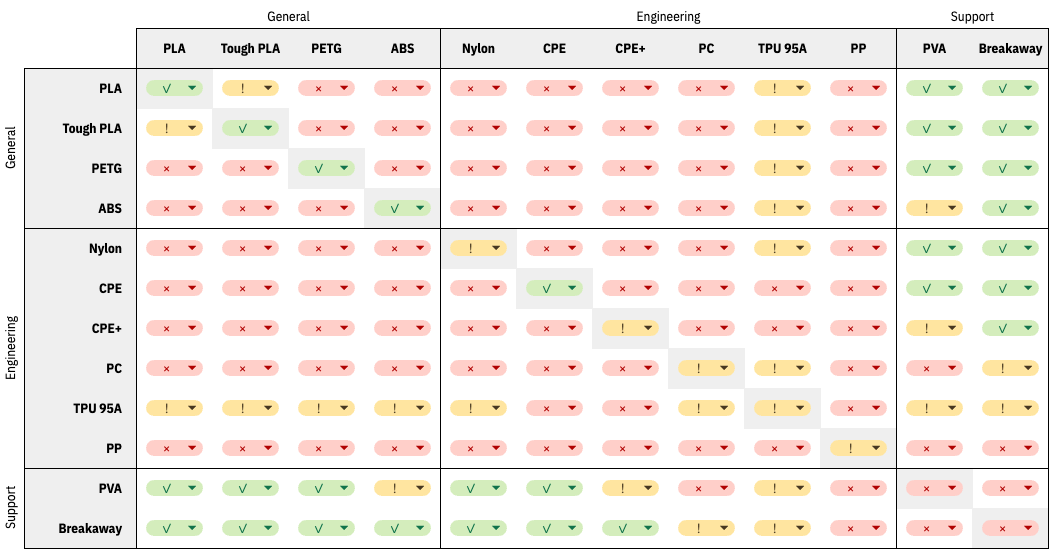
Tip: The icons in the table reflect the compatibility and support of the combination. Officially supported ( ✓ ), not supported ( × ), or experimental ( ! ). Results are dependent on the model type that is used. For more information on why a material combination is listed as experimental, visit the How to print guides of these materials.
Note: The composite materials (PET CF, Nylon CF Slide, and PPS CF) are excluded from this overview. Although these materials support dual combinations with other materials, they are not compatible with the UltiMaker 3 and 3 Extended.
UltiMaker materials vs third-party materials
Although the use of UltiMaker materials is recommended, the UltiMaker 3 has an open material system. You can choose from a wide range of materials to select what works best for your application and workflow.
UltiMaker materials
Using materials from UltiMaker's own portfolio offers the following benefits:
- Profiles: All UltiMaker materials have been tested extensively and have optimized profiles in UltiMaker Cura to ensure the best print result.
- NFC detection: UltiMaker material spools feature an NFC tag, which contains information about the material type and color. The spool holder recognizes the filament when a new spool is placed, to facilitate the material loading process.
- Integration: The material information is also directly transferred to UltiMaker Cura and the Digital Factory when the printer connected via the network. This makes it simpler and quicker to select the right configuration in Cura and streamlines remote print job management.
Third-party materials
The UltiMaker 3 also supports printing with third-party materials.
Note: While many different types of filaments can be used on the UltiMaker 3, note that this printer is only set up for 2.85 mm materials, and the use of composite materials on this printer is not supported.
Check the UltiMaker Marketplace for compatible material profiles for the best results. You can filter on printer and print core compatibility to ensure you're only finding profiles that match your hardware. Additionally, there are filament-specific filters, such as for characteristics and polymer types, to look for ideal filaments for your application. Add new profiles to Cura via the Marketplace, and sync them to your printer for optimized workflows.
If the material type or brand is not available in the Marketplace, you can create print profiles manually. Please always carefully check the material and printing specifications with your filament supplier to ensure that you select the right settings in Cura, and that the filament can be printed safely within the limitations of the UltiMaker 3 hardware and firmware. Take into account things like temperature (nozzle, build plate, and build volume), diameter / roundness, and the need for ventilation.
Print settings
Each material requires different settings for optimal results. If you use UltiMaker Cura to prepare your model, these settings are automatically set correctly if the correct print core(s) and material(s) are selected.
Note: For all materials that are supported on the UltiMaker 3, it is also recommended to apply a thin layer of glue or an adhesion sheet to the glass plate before starting a print. This will make sure that your print adheres well to the glass plate.
For detailed instructions on which settings and adhesion methods to use per material, consult the How to print guides per material, or check the page on glue-type recommendations.