Correct handling of PVA is key to success. Full details can be found in our UltiMaker PVA leaflet.
PVA that is stored over a long time or exposed to moisture can show a decreased print quality and reliability.
- PVA that is stored over a long time, incorrectly stored or incorrectly dried can become more brittle. This is partly reversible by annealing to release stresses in the material. The procedure can be found here. When the filament is degraded and highly crystallised, the brittleness can not be completely released and this leads to a higher chance of failure due to material handling and a higher chance of nozzle clogs. Therefore, a shelf life of 1 year is recommended.
- PVA that is exposed to moisture shows decreased print quality and higher chance of print core clogging. Not only the support will show more ooze, but there is also a risk of holes in the build material due to improper extrusion. It is recommended to ensure that the filament is kept in good condition or to dry UltiMaker PVA before use.
Below tests will help you to recognise brittleness or moisture in the PVA.
Brittle PVA
Brittleness can be easily detected by bending the filament at a few places. Generally the end of the spool is more brittle due to the smaller curvature. Crystallised PVA can be recognised by a more milky instead of transparent appearance.
Moisture - oozing
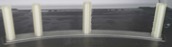
Moisture can be detected during printing, especially when the print head is travelling for longer distance. The following oozing test will easily show the condition. When more than 1 pillar has oozing residue it is required to dry your PVA. The print file can be found in the attachment. in addition to a universal Cura project file. Generally, it is required to dry your PVA when the filament is exposed to office conditions (room temperature, 20°C and 55% relative humidity (RH)) for 2 weeks.